Environmental Health
Water Filtration & Reverse Osmosis: How to Choose by Contaminant, NSF Claim & Cost
The right filter is a claim matched to a lab result—not a marketing sticker. This guide maps microbes, metals, PFAS, nitrate, and chlorine to technologies, NSF standards, RO setup, and real maintenance.
Medical disclaimer: Informational public-health editorial only—not medical advice, product endorsement, or a substitute for state-certified laboratory testing or licensed clinical care. Regulations (especially PFAS) evolve; verify live EPA and state requirements before capital projects.
Buying a water filter without a target contaminant is like buying a medicine without a diagnosis. Barriers are non-interchangeable: microbes are not metals; PFAS is not chlorine; hardness is not nitrate. The durable sequence is test → map claim → treat → maintain → retest. Hardware-first shopping is the master anti-pattern of the entire category.
This guide is the engineering companion to chemical pillars on PFAS, fluoride, and microplastics in the environmental health section. It decodes technologies, NSF/ANSI claims, reverse-osmosis grammar, remineralization, point-of-use versus point-of-entry, cost bands, and sex- and life-stage priorities for pregnancy and infancy.
Key takeaway: Match every dollar of filtration to a certified lab or CCR analyte and a listed NSF/ANSI claim on the exact model. Maintenance is part of safety. Whole-house RO is rarely the default.
Which contaminants matter, and what are the key policy numbers?
Microbes: Public systems use treatment technique rules and coliform indicators; wells need annual coliform testing at minimum. Barriers that work include UV Class A (NSF/ANSI 55, 40 mJ/cm² dose class), RO with integrity/cyst claims, distillation, and boiling—not aesthetic pitchers alone. Legionella can grow in premise plumbing even when the municipal plant is compliant.
Metals: Lead has an MCLG of zero; action-level policy has been moving toward 10 µg/L in modern lead-rule direction (legacy materials often cite 15 µg/L—verify current LCR implementation). Arsenic MCL is 10 µg/L; copper action level 1.3 mg/L. First-draw sampling matters for premise lead. Never boil to “remove” metals.
PFAS: 2024 national MCLs set PFOA/PFOS at 4.0 ppt and other regulated PFAS at 10 ppt with a mixture Hazard Index. Treatment at utility and home scale centers on GAC, anion exchange, and RO/NF—not coagulation or chlorine. See EPA’s PFAS treatment and home-filter fact sheets; date-check rules because non-PFOA/PFOS pieces can move in proposals.
Disinfectants, DBPs, hardness, nitrate: Chlorine and chloramines have MRDLs of 4.0 mg/L as Cl₂; TTHM and HAA5 MCLs are 80 and 60 µg/L. Free chlorine responds to standard carbon (42); chloramine often needs catalytic carbon. Softeners (44) address scale, not health primaries. Nitrate-N MCL is 10 mg/L (nitrite-N 1 mg/L)—critical for infant methemoglobinemia; RO, anion exchange, or distillation apply; boiling concentrates nitrate.
| Technology | Strong on | Weak / not for | Primary NSF/ANSI | Typical locus |
|---|---|---|---|---|
| Sediment | Particles; protects downstream | Dissolved anything | Component | POE/POU pre |
| Carbon GAC/block | Cl₂, taste, many organics, lead* | Nitrate, microbes*, short PFAS early | 42, 53*, 401* | Pitcher→POE |
| Catalytic carbon | Chloramine | Same carbon limits | 42 chloramine* | POE/POU |
| Softener (cation IX) | Hardness Ca/Mg | Microbes, PFAS, organics | 44 | POE |
| Anion IX | Nitrate, some As, many PFAS | Non-ionics, microbes | Product-specific | POU/POE |
| UV Class A | Bacteria, viruses, cysts | All chemicals/metals | 55 | POE well |
| RO | TDS, metals, NO₃, F, PFAS, many organics | Some gases/VOCs without carbon; waste stream | 58 (+42 stages) | POU under-sink |
| Distillation | Inorganics, microbes | Some VOCs (co-distill); energy | 62 | Countertop |
*Only when specifically certified for that analyte on the exact model.
How do filter technologies and combinations actually work?
Rules of combination prevent expensive failures:
- Sediment always upstream of carbon, RO, and UV.
- Carbon before thin-film-composite RO membranes on chlorinated water (chlorine oxidizes membranes).
- UV only on low-turbidity water.
- Softeners never substitute for microbial, PFAS, or lead claims.
- Stack standards deliberately: e.g., 42+53+401 carbon towers; 58 RO core with optional health listings.
Decision sketch: if analytes include nitrate, arsenic, multi-TDS, or multi-PFAS, prefer RO and/or ion exchange. If free chlorine taste and listed lead only, a 53 carbon system may suffice. If coliform risk on a clear well, UV-A or RO-plus-disinfection strategies apply. If scale only, softener POE. One-filter-to-rule-them-all marketing is how nitrate “filters” that are only carbon pitchers get sold to parents.
Performance norms to keep realistic: RO PFAS rejection often exceeds 90% when designed and certified; residential waste ratios commonly land near 1:1 to 4:1 depending on recovery features. GAC PFAS works best on longer chains; monitor short-chain breakthrough. UV Class A targets 40 mJ/cm² with alarms. Distillers need VOC venting or carbon and high energy input.
How should you configure RO, shop NSF claims, and budget maintenance?
Canonical under-sink RO grammar:
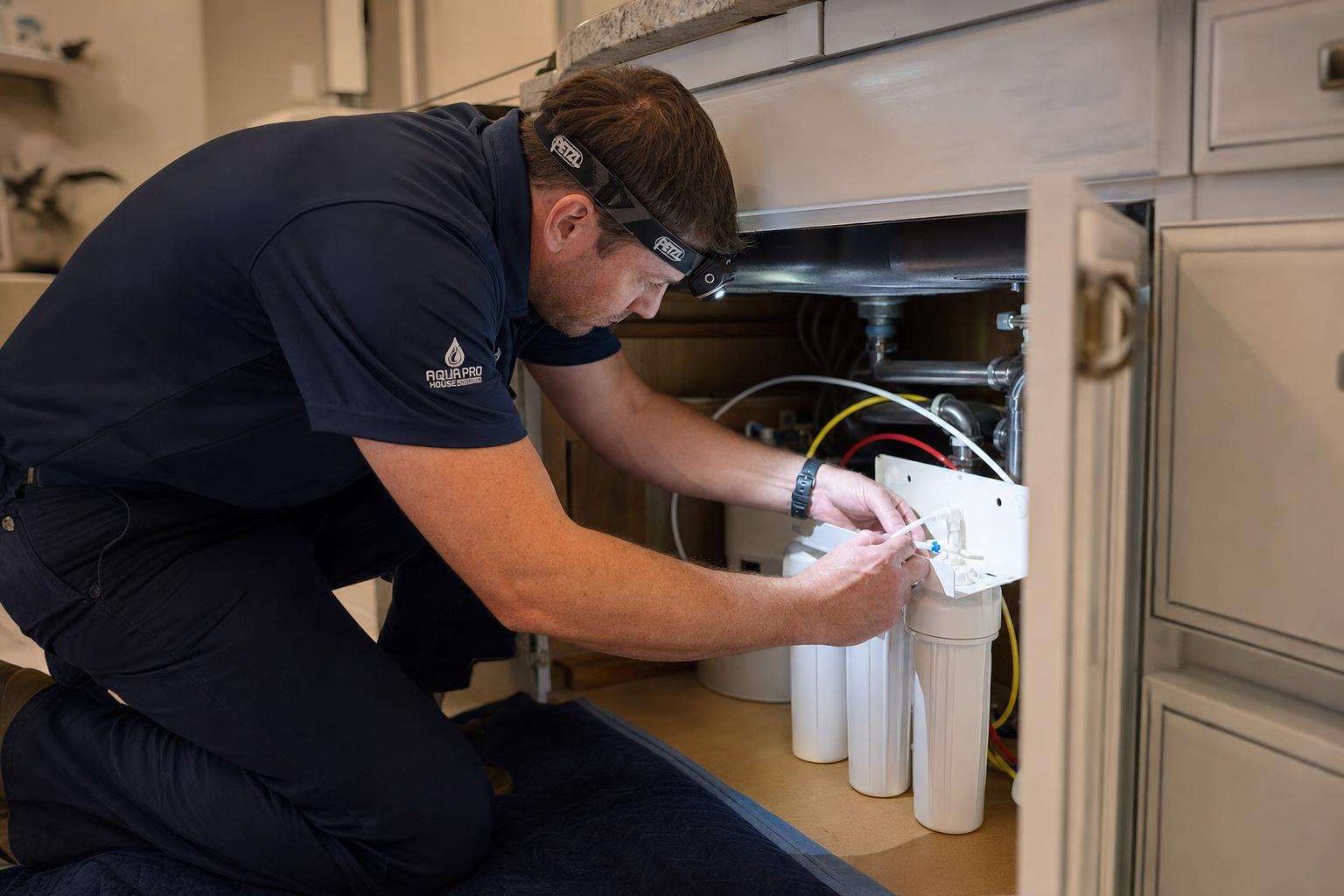
Sediment → carbon (Cl₂/chloramine control) → RO membrane → storage or tankless → post-carbon → optional remin (± UV on tank).
NSF shopping protocol:
- Identify analytes from a certified lab report or CCR (plus lead service-line inventory where relevant).
- Require a listed claim on the exact model in a certifier directory.
- Read the performance data sheet: challenge level, effluent maximum, percent reduction, capacity gallons, flow.
- Reject “tested to” language without listing.
- For PFAS, follow EPA’s pointer to 53 or 58 PFOA/PFOS reduction certifications and change media on schedule.
Configuration defaults:
- Renter / light aesthetic risk → pitcher 42/53 with listed claims.
- Urban premise lead → under-sink 53 or RO with lead listing; flush cold; address service lines when applicable.
- Multi-contaminant well → RO ± UV ± softener hybrid.
- Chloramine city comfort → catalytic carbon POE plus POU health stage.
Cost and TCO: pitchers $20–80; under-sink carbon $100–400; RO $150–950 capital before install; POE softeners and multi-media systems higher. OPEX is annual filter kits, multi-year membranes, lamps, water waste, and septic considerations for brine plus RO reject. Monitor RO integrity roughly via feed versus product TDS, knowing TDS is not metal-specific. Sanitize tanks; never run dry membranes. Remineralization is taste/corrosion management, not a metabolic therapy—link metabolic mineral nutrition questions to metabolic health rather than overselling RO cartridges.
Who needs extra caution, and what is the decision sequence?
Pregnancy, fetal, and infant stages escalate lead (neurodevelopment), nitrate (infant methemoglobinemia), arsenic, PFAS (developmental and immune signals), and microbes for formula safety. CDC advises testing wells when pregnant or when a child arrives. Use cold water for formula preparation after appropriate treatment; never rely on hot-tap water. Men’s reproductive literature for PFAS and lead is multi-route and graded carefully—engineering controls help, but filters are not fertility cures. Women’s non-pregnant life stages still face bone-lead mobilization risks later in life and PFAS milk-transfer considerations discussed in the PFAS pillar.
Canonical decision sequence for every household:
- Source — city vs well.
- Measure — CCR and/or certified lab.
- Map — detect → technology → NSF claim.
- Locus — POU, POE, or hybrid.
- Verify — cert directory + performance data sheet.
- Maintain + retest — calendar and budget OPEX.
Consolidated anti-patterns: buy RO first, test never; equate filtered with sterile; boil chemical hazards; NSF sticker without analyte; softener as universal purifier; whole-house RO without corrosion engineering; neglect changeouts especially on PFAS media; pitcher-only for nitrate or arsenic; mineral fear blocking needed toxin RO; influencer kits replacing certified labs; alkaline medical claims.
Primary references include the EPA National Primary Drinking Water Regulations, EPA home PFAS filter fact sheet, CDC well-testing guidelines, and NSF/ANSI 42/53/58 documentation. For recovery lifestyle factors that do not replace water chemistry, see light and recovery.
Sources & citations
Frequently asked
Questions & answers
What is reverse osmosis and what does it remove?
Reverse osmosis (RO) forces water through a semi-permeable membrane that rejects many dissolved salts, metals, nitrate, fluoride, and a wide range of organic contaminants, including many PFAS (often greater than 90% rejection in controlled studies—verify the exact model claim). Residential systems typically stack sediment prefiltration, carbon to protect the membrane from chlorine, the RO membrane, storage or tankless delivery, and post-carbon polishing, with optional remineralization. NSF/ANSI 58 is the core RO drinking-water standard; it always requires TDS reduction and may list optional claims for lead, arsenic, nitrate, fluoride, cysts, VOCs, or PFAS depending on the product. RO does not magically remove every gas or VOC without carbon stages, produces concentrate wastewater, and is usually sized for drinking and cooking—not whole-house flow.
Is reverse osmosis better than a carbon filter?
Neither is universally better; they solve different problems. Activated carbon (NSF/ANSI 42 for aesthetic chlorine/taste; NSF/ANSI 53 for health claims such as lead when listed) excels at free chlorine, many organics, taste, and some metals when certified. Carbon is weak for nitrate, hardness, microbes, and often short-chain PFAS breakthrough without careful design. RO is stronger for multi-contaminant dissolved suites—nitrate, arsenic, fluoride, TDS, multi-PFAS—especially on private wells. For chloraminated cities, catalytic carbon may be needed before or instead of standard carbon for residual control. Choose by certified lab or Consumer Confidence Report analytes, not brand hierarchy. Many strong under-sink systems combine both: carbon stages plus an RO membrane with listed claims.
Do I need to remineralize RO water?
RO removes a large fraction of calcium and magnesium—often cited around 94–98%—so product water can taste flat and be more aggressive toward metal plumbing if used whole-house. Point-of-use remineralization (calcite or magnesium stages after the membrane) is primarily about taste and corrosivity management, not multivitamin therapy. People with adequate diets obtain the overwhelming majority of minerals from food, not drinking water. Prefer under-sink RO so demineralized water is not forced through the entire premise. Do not market alkaline remineralization cartridges as disease treatment. Replace remin media on schedule like any other stage, and never let mineral fear block needed RO when toxins such as nitrate, arsenic, or PFAS drive the decision.
What NSF standards matter for home water filters?
Certification is claim- and model-specific. Common standards include NSF/ANSI 42 (aesthetic chlorine, taste/odor), 53 (health effects such as lead when listed), 58 (reverse osmosis), 401 (emerging compounds when listed), 44 (softeners), 55 (UV Class A/B), and 62 (distillation). A generic “NSF” sticker without the analyte on the performance data sheet is marketing noise. For PFAS, EPA consumer materials point to filters certified for PFOA/PFOS reduction under 53 or 58 by accredited certifiers. Read challenge levels, maximum effluent, percent reduction, capacity in gallons, and flow rate. Reject phrases like “tested to NSF” that are not directory-listed certifications for your exact model number.
How should private well owners test before buying a filter?
Private wells are not regulated by EPA under the Safe Drinking Water Act the way public systems are—owners are responsible. CDC recommends testing at least annually for total coliform, nitrate, TDS, and pH, and retesting with pregnancy, a new infant, flooding, or taste/odor changes. Add regional panels for arsenic, PFAS, VOCs, and pesticides based on local geology and land use. Use state-certified laboratories only. Map detects to technology: microbes may need UV Class A (40 mJ/cm² dose class) or RO-plus-disinfection strategy; nitrate and many metals favor RO or anion exchange; PFAS favors certified GAC, anion exchange, or RO. Boiling fixes microbes only and concentrates nitrate and metals. Pregnancy and infancy escalate the priority of lead, nitrate, arsenic, PFAS, and microbial safety.
How much does a home RO system cost to buy and run?
Indicative market bands (not quotes): pitchers roughly $20–80; under-sink carbon systems roughly $100–400; under-sink RO roughly $150–950 capital; whole-house softeners and multi-stage POE systems often $800 to several thousand installed. EPA’s PFAS home-filter fact sheet notes consumer filter costs spanning about $20 to more than $1,000 depending on type. Operating costs include 6–12 month carbon changes, multi-year membranes, UV lamps if present, water waste (residential RO reject ratios often ~1:1 to 4:1 product:waste depending on design), and certified replacement parts. Compute a five-year total cost of ownership. Maintenance is safety—EPA notes neglected PFAS filters can increase exposure risk. Whole-house RO is rarely justified for homes compared with hybrid POE comfort treatment plus POU health-stage RO.