Environmental Health
Microplastics and Human Health: Exposure, Organ Evidence & What Actually Reduces Dose
Humans take in tens of thousands of plastic particles yearly from diet and air—and landmark studies have found plastics in blood, plaque, placenta, and brain tissue. Here is how to read the evidence without credit-card myths.
Medical disclaimer: This guide synthesizes environmental-health research for education only. It is not medical diagnosis, treatment advice, or a product endorsement. Clinical decisions belong with licensed clinicians; lab and method details determine what any particle number actually means.
Microplastics are no longer only an ocean-story problem. They are a human multi-route exposure—food, water, air, and dust—with polymers and additives now measured in blood, placenta, atherosclerotic plaque, brain tissue, semen, and follicular fluid. The science is simultaneously impressive and incomplete: detection is strong; ambient-dose disease causation is limited. Reading that gap honestly is the difference between useful prevention and viral misinformation.
This pillar defines size bands and methods, maps exposure pathways with real numbers, grades health claims (including the Marfella cardiovascular association), and ranks reduction steps that actually move dose. For chemical co-exposures carried by plastics and packaging, cross-link to our PFAS guide and fragrance EDC coverage in the environmental health hub. Water hardware details live in the reverse-osmosis guide.
Key takeaway: Count is not mass. Presence is not proven ambient disease. Habitual plastic bottles, heat-in-plastic, laundry microfibers, and indoor dust are higher-leverage personal cuts than detox products—and the “credit card of plastic per week” claim is not a valid human dose metric.
How should microplastics and nanoplastics be defined and measured?
Operational definitions matter before any headline number. Microplastics are plastic particles under 5 mm (EPA and environmental-science conventions). Nanoplastics are generally under 1 µm. Primary particles are made small; secondary particles fragment from larger items. Fibers from textiles are a dominant indoor morphology.
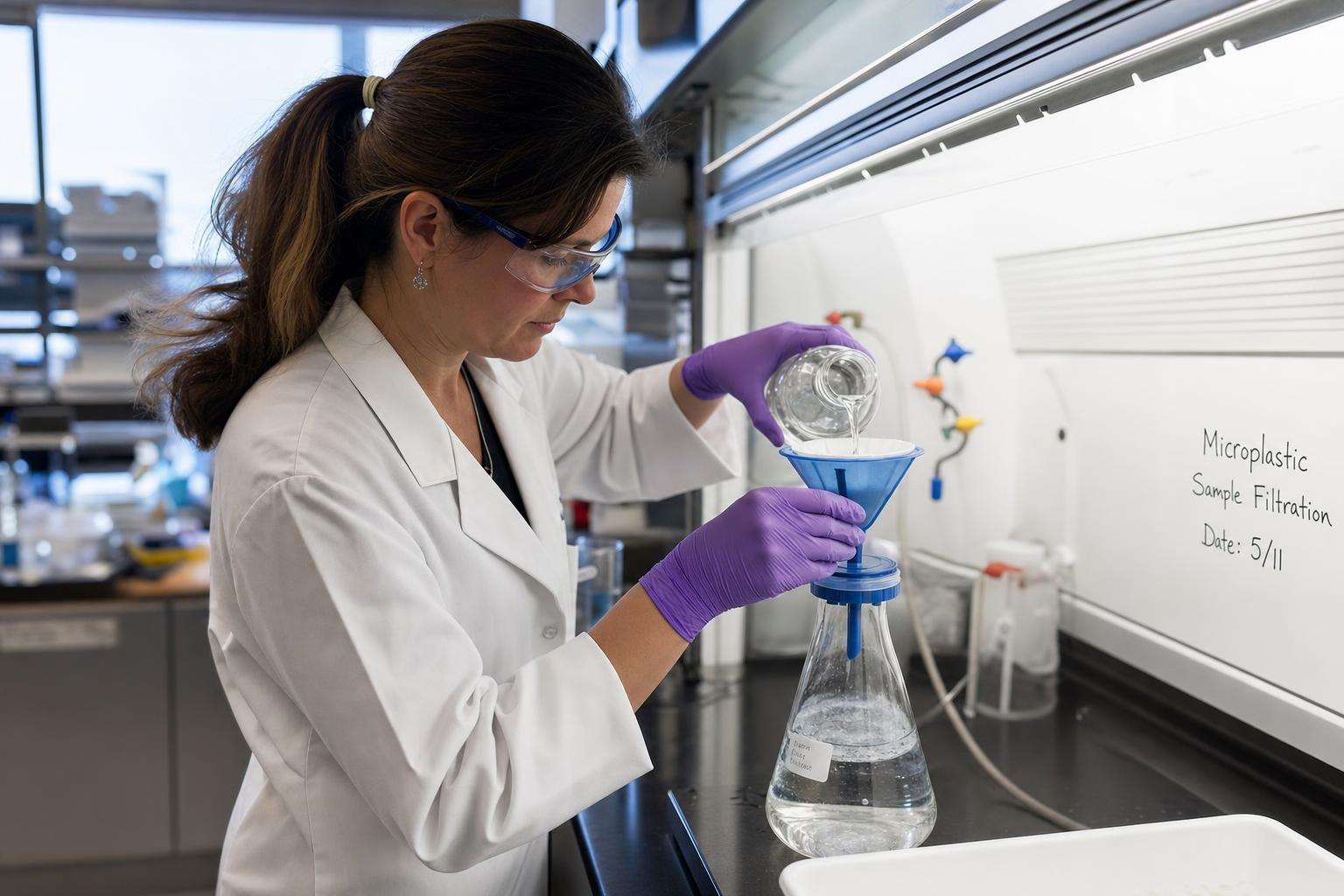
Methods are not interchangeable. Micro-FTIR and Raman spectroscopy identify particles above method size floors. Pyrolysis–GC/MS reports polymer mass without morphology. Advanced stimulated Raman approaches (as in Qian’s bottled-water work) push into nano counts. Quality assurance—blanks, recoveries, limits of quantification, clean labware—separates science from contamination theater. Koelmans and others have detailed how easy it is to over-count without blanks.
Dose rules for readers and writers:
- Prefer published native units; never silent mass↔count conversion.
- Cox’s diet model covers roughly 15% of calories—lower bound, not total lifetime plastic mass.
- Tissue mass is not ingested mass storytelling.
- Reject the credit-card-per-week meme as human intake fact (Pletz 2022).
| Metric | Value | Source |
|---|---|---|
| Partial U.S. diet particles/year | ~39,000–52,000 | Cox 2019 ES&T |
| Diet + inhalation/year | ~74,000–121,000 | Cox 2019 |
| Bottled water particles/L | ~2.4×10⁵ (~90% NP in study) | Qian 2024 PNAS |
| Blood positivity | ~77% (17/22) | Leslie 2022 |
| Carotid plaque positivity | 58.4% (150/257) | Marfella 2024 NEJM |
| Brain vs liver/kidney mass | ~7–30× higher (study comparisons) | Nihart 2025 |
How do microplastics enter the human body?
Water: Both tap and bottled water can contain microplastics; method floors change totals dramatically. Nano-era bottled-water results make habitual plastic-bottle hydration a high-leverage personal reduction when municipal water is otherwise safe. WHO’s 2019 drinking-water review did not recommend routine MP monitoring as a primary public-health priority over pathogens and classical chemicals—context that still matters when allocating anxiety and budget.
Food and packaging: Diet estimates from Cox remain the baseline partial inventory. Seafood, salt, produce, and food-contact materials all contribute, but monocausal “only seafood” stories fail. EFSA’s ongoing food-contact work notes real release with incomplete nano data and exposure estimation gaps; FDA states that microplastics and nanoplastics in foods have not been shown to pose a risk at currently detected levels while research continues. Practical rule: heat × plastic = avoid.
Air and dust: Inhalation can roughly double or triple annual particle counts versus diet-only models. Indoor textile fibers dominate many homes; outdoor tire and road wear contribute outdoors. Children have higher dust-ingestion rates. Respiratory endpoints appear in Chartres’s “suspected” harm set.
Textiles and dermal routes: Washing and wearing synthetic fabrics emit microfibers; laundry filters can capture a large fraction of shed fibers in product and lab tests (often cited ~80–98%). Intentional microbeads face restrictions in U.S. cosmetics and broader EU intentional synthetic polymer microparticle rules (REACH 2023/2055), but secondary microplastics remain the bulk problem. Intact skin is a poor absorber of solid particles compared with chemical leachables.
What does organ deposition evidence say about health risk?
Deposition anchors are now multi-organ: blood (~77% in Leslie’s small cohort), placenta (Ragusa), plaque (Marfella), brain mass elevations versus liver/kidney (Nihart), plus semen and follicular-fluid reports. Mechanisms split into particle-driven inflammation (ROS, inflammasome, cytokines, foreign-body responses) and chemical EDC pathways from additives—keep those ledgers separate unless data justify merging. Surface corona and adsorbed pollutants add a third axis in environmental particles.
Working grades for editorial honesty:
- Multi-organ presence: strong observational.
- Inflammation biology: strong preclinical; emerging human.
- Cardiovascular events: important NEJM association; not settled causal.
- Reproductive, digestive, respiratory: suspected (Chartres 2024).
- Population attributable risk %: unknown.
Sex stratification matters for reproductive claims. Men’s literature includes semen and testis particle detections and motility associations, with animal models showing spermatogenic injury. Women’s literature includes placenta and follicular fluid detections and animal ovarian toxicity signals; perinatal windows deserve priority. Shared home air, water, and dust mean household interventions help both axes. ART or surgical cohorts are not the general population.
Anti-patterns to refuse: leaping from detection to monocausal fertility collapse; dosing people with in-vitro milligram-per-milliliter logic; claiming brain plastics equal “plastic spoon” clinical dosing; or asserting that “BPA-free” equals microplastic-safe.
What reduction steps and policy changes actually matter?
Personal stack (exposure reduction, not medical cure):
- Drink tap water from glass or steel when the supply is safe; drop habitual PET bottles.
- Never heat food in plastic; prefer glass, ceramic, and stainless for hot contact.
- Laundry: full cooler loads, less fleece when practical, microfiber capture filters.
- HEPA vacuum, damp dust, entry mats—especially with kids.
- Optional certified drinking-water filtration matched to pore claims and chemical co-contaminants (PFAS, lead, nitrate).
Policy landscape: EU REACH restriction 2023/2055 phases down intentionally added synthetic polymer microparticles; the U.S. microbead cosmetic ban is narrower. Secondary microplastics from tires, textiles, and packaging need design, wastewater, and extended-producer-responsibility tools. There is still no universal particle health-based guidance value for food and water MNPs worldwide. WHO, FDA, and EFSA language remains research-forward and cautious rather than “all clear” or “catastrophe proven.”
Communication grammar for this topic should always state Known / Unknown / Next. Verbs matter. Myths to scrub: credit-card weekly mass; “Europe banned all microplastics”; “bottled is purer”; “microbead ban solved it”; detox supplements as medicine.
For hardware decisions when water chemistry co-dominates risk, use the water filtration and reverse osmosis guide. When plastic packaging co-carries forever chemicals, read the PFAS complete guide. Metabolic inflammation pathways that interact with environmental load are covered under metabolic health; recovery stressors under light and recovery.
Primary anchors for this article include Cox et al. 2019, Qian et al. 2024 PNAS, Marfella et al. 2024 NEJM, Chartres 2024, WHO drinking-water microplastics reports, FDA food pages, and EPA microplastics research overviews. Methods and blanks first; panic last.
Sources & citations
- Environmental Science & Technology (Cox et al. 2019) — Human Consumption of Microplastics
- PNAS (Qian et al. 2024) — Rapid single-particle chemical imaging of nanoplastics
- New England Journal of Medicine (Marfella et al. 2024) — Microplastics and Nanoplastics in Atheromas and Cardiovascular Events
- World Health Organization — Microplastics in drinking-water
- U.S. FDA — Microplastics and Nanoplastics in Foods
Frequently asked
Questions & answers
What are microplastics and nanoplastics?
Microplastics (MPs) are plastic particles smaller than 5 millimeters down to roughly the micrometer scale; nanoplastics (NPs) are generally defined as particles under 1 micrometer (some engineered-nanomaterial definitions use 1–100 nanometers—always declare which band you mean). Particles may be primary (manufactured small, such as former cosmetic microbeads) or secondary (fragmented from larger plastics). Morphology includes fragments, films, foams, spheres, and fibers. Common polymers detected in human and environmental studies include polyethylene, PET, polystyrene, polypropylene, PMMA, polyamide, and PVC. Dual hazard matters: particle physics (inflammation, translocation) and additive or leachable chemistry (phthalates, bisphenols, flame retardants) are separate ledgers that should not be silently merged.
How many microplastics do people ingest each year?
The most cited partial-diet estimate is from Cox and colleagues (2019): about 39,000–52,000 particles per year from a limited U.S. diet model, rising to roughly 74,000–121,000 when inhalation is included. That model covers only a fraction of calories and predates many nanoplastic-capable methods, so treat it as a lower-bound sketch, not a full-body mass budget. Bottled water can dominate liquid exposure in nano-aware studies—Qian and colleagues reported on the order of 240,000 particles per liter in bottled water, with about 90% in the nanoplastic size range depending on method. Always keep units native: particle counts are not interchangeable with mass. The popular “credit card of plastic per week” mass claim is invalid as a human dose story (Pletz 2022) and should not appear as fact.
Have microplastics been found in human organs?
Yes—multi-organ deposition is now repeatedly reported, though methods and blank controls still limit comparison across studies. Leslie and colleagues detected plastics in blood in about 77% (17 of 22) of donors. Ragusa and colleagues reported plastics in human placenta samples. Marfella and colleagues found micro- and nanoplastics in carotid plaque in 58.4% (150 of 257) of patients and observed higher rates of a composite of myocardial infarction, stroke, or death among those with detected plaque plastics—an important observational association, not settled causation. Nihart and colleagues reported higher plastic mass concentrations in brain tissue relative to liver and kidney (on the order of roughly 7–30× depending on comparisons). Semen and follicular fluid detections are emerging. Presence proves exposure biology; it does not by itself prove ambient-dose disease attribution for every endpoint.
Do microplastics cause disease in people?
The honest grade is mixed by endpoint. Multi-organ presence is strong observational science. Inflammation biology is strong in preclinical models and emerging in humans. Cardiovascular events have a landmark NEJM association (Marfella 2024) that still needs causal triangulation. A 2024 systematic review by Chartres and colleagues graded reproductive, digestive, and respiratory harms as suspected rather than proven at ambient human doses. WHO and FDA statements have emphasized research needs and, for food, no demonstrated risk at detected levels under current evidence—while also noting major measurement gaps, especially for nanoplastics. Population attributable risk percentages for ambient microplastic exposure remain largely unknown. Use verbs carefully: detected, associated, suspected, hypothesized—not “proven to cause” for every organ story.
What actually reduces microplastic exposure at home?
High-leverage steps target water, heat-with-plastic, laundry fibers, and indoor dust. Prefer tap water in glass or steel over habitual PET bottled water when municipal water is safe. Never heat food in plastic; use glass, ceramic, or stainless for hot food and drinks. Run full, cooler laundry loads, reduce fleece shedding when practical, and consider microfiber-capture filters (literature and product tests often claim roughly 80–98% fiber capture—verify independent data). Use HEPA vacuuming, damp dusting, and entry mats, especially for children who ingest dust. Optional certified drinking-water filters may help for some particle sizes, but pore rating and maintenance matter; reverse osmosis and ultrafiltration claims should be model-specific. Intentional microbead bans do not solve secondary microplastics from tires, textiles, and packaging. Disclose the limit: exposure reduction is not a proven disease cure.
Is bottled water safer than tap water for microplastics?
Often the opposite for plastic particles. Nano-aware bottled-water measurements (including Qian 2024 PNAS work) show very high particle counts, largely nanoplastics, compared with older micro-only surveys. Municipal tap water can contain microplastics, but habitual plastic-bottle hydration is a high-leverage personal cut when tap chemistry and microbes are already controlled. WHO’s drinking-water microplastics reviews historically prioritized pathogens and classical chemical risks over routine MP monitoring mandates. Always solve lead, nitrate, PFAS, and microbial safety with testing and appropriate treatment first—microplastics are an additive concern, not a reason to abandon a well-managed public supply for endless single-use PET. Pair this topic with certified filtration when chemical contaminants co-exist; see our reverse-osmosis and PFAS guides under environmental health.