Environmental Health
PFAS Forever Chemicals: Complete Guide to Exposure, Health Evidence & Mitigation
EPA drinking-water MCLs are now 4.0 ppt for PFOA and PFOS. Here is how forever chemicals enter the body, what half-lives and biomonitoring tiers mean, and which filters actually work.
Medical disclaimer: This article is educational environmental-health reporting for orientation only. It is not personalized medical, legal, or engineering advice. Clinical care, well remediation, and regulatory compliance require licensed professionals and primary standards documents.
Per- and polyfluoroalkyl substances—better known as PFAS or “forever chemicals”—are no longer a niche industrial story. They are a water-infrastructure, biomonitoring, and product-chemistry problem with concrete U.S. drinking-water numbers as of April 2024. If you only remember one policy fact, make it this: the U.S. EPA set maximum contaminant levels of 4.0 ppt for PFOA and 4.0 ppt for PFOS, with additional 10 ppt limits and a mixture Hazard Index for other regulated PFAS. Older “70 ppt combined” messaging is retired for current MCL discussions.
This guide maps chemistry and half-lives, exposure triage, health evidence grades, testing, and mitigation—without detox theater. For the filtration engineering stack that often accompanies PFAS work, see our environmental health hub and the companion water-filtration pillar. Related metabolic context lives under metabolic health when lipids and thyroid follow-up enter the clinical conversation.
Key takeaway: Treat contaminated drinking water first. Product swaps for packaging and cosmetics matter, but they are secondary when a plume is in the tap. Zero PFAS exposure is currently unachievable; harm reduction is the honest goal.
What are PFAS, and how long do they stay in the body?
Under the OECD structural definition, PFAS share fully fluorinated carbon features that make many members environmentally persistent. That is not the same claim as “infinite biological half-life.” Human toxicokinetics vary by chain length and head group. Mean serum half-lives reported by Li and colleagues include roughly 2.7 years for PFOA, 3.4 years for PFOS, and 5.3 years for PFHxS, while ATSDR ranges stretch wider (for example PFOS spanning years to decades in some estimates). Short-chain replacements often clear faster but remain environmentally mobile and still PFAS by structure.
Because many long-chain PFAS bind plasma proteins, biomonitoring uses serum, not fat biopsies. Body burden integrates water, food (especially contaminated fish in some locales), dust from treated textiles, occupational AFFF, and lower-dose consumer sources. Legacy serum levels of PFOS and PFOA have declined substantially in U.S. biomonitoring since the late 1990s—PFOS by more than 85% and PFOA by more than 70% in long NHANES windows—yet near-universal low-level detection remains.
| Compound | EPA MCL role (2024) | Half-life note | Treatment tendency |
|---|---|---|---|
| PFOA | 4.0 ppt (MCLG 0) | ~2–3+ years mean | GAC good; RO excellent |
| PFOS | 4.0 ppt (MCLG 0) | ~3–7+ years (wide range) | GAC good; RO excellent |
| PFHxS | 10 ppt + Hazard Index | Often longest among legacy | GAC moderate–good; RO preferred |
| PFNA | 10 ppt + HI | ~2.5–4+ years class | GAC/RO |
| HFPO-DA (GenX) | 10 ppt + HI | Shorter than legacy long-chain | Variable GAC; RO preferred |
| PFBS | HI only (high HBWC) | Days–weeks class | GAC weak early; RO better |
Regrettable substitution is real: long-chain phase-outs pushed industry toward short-chain and ether PFAS that still persist. “PFOA-free” cookware or packaging marketing is not a total-fluorine guarantee.
Where does PFAS exposure come from, and what should you fix first?
Dose impact is not equal across lifestyle tips. The practical hierarchy starts with high-volume, high-concentration routes:
- Contaminated drinking water (public systems or private wells near airports, military bases, manufacturing, landfills, or biosolids land application).
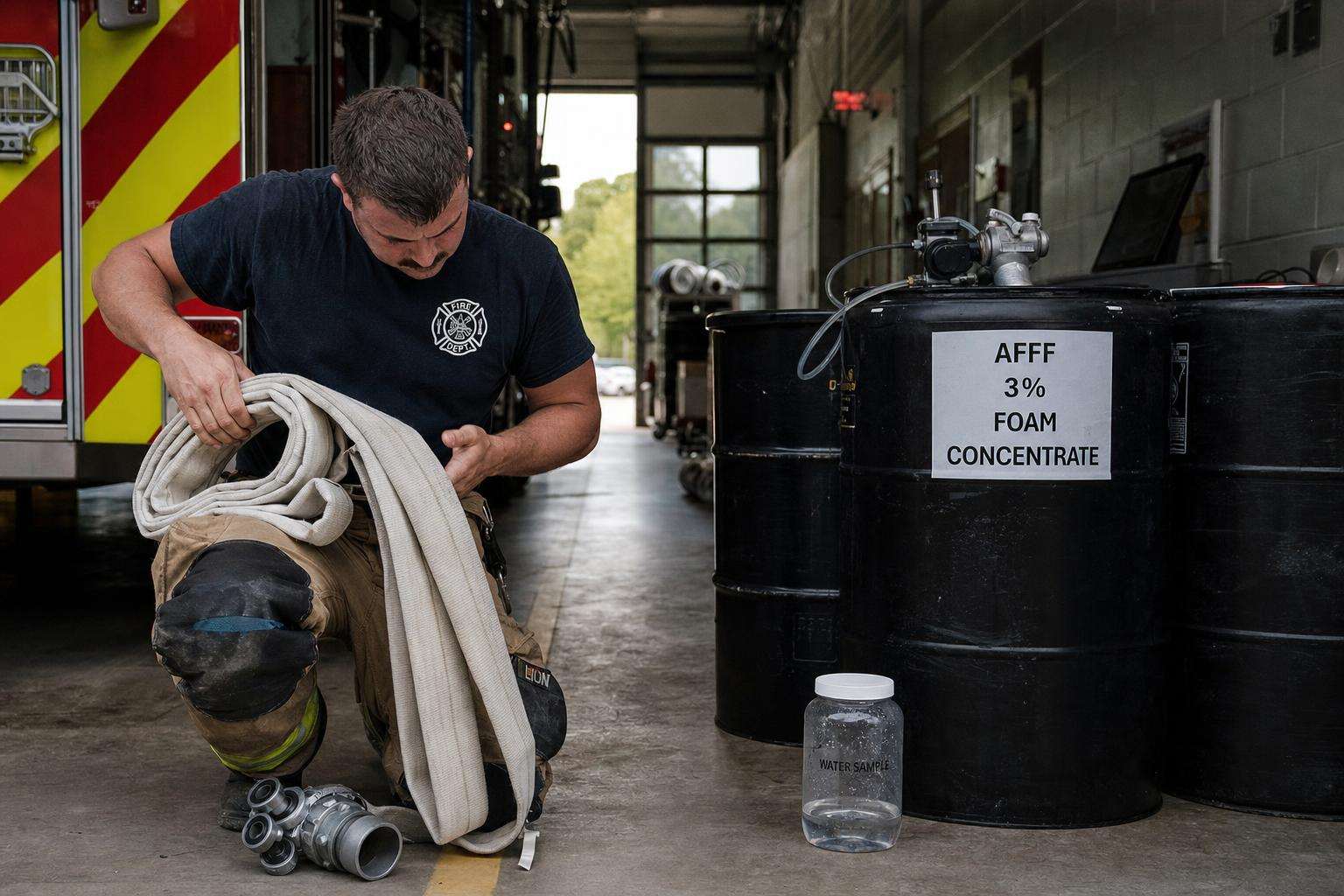
- Occupational AFFF and manufacturing (firefighters and industrial workers; sulfonate-dominant serum patterns are common at AFFF sites).
- Contaminated local fish and regional food under advisories.
- Grease-proof packaging and house dust from treated textiles and carpets—especially relevant for toddlers who ingest dust.
- Cosmetics and cookware—usually lower contribution unless specialty or occupational.
Boiling water never “removes PFAS”; it can concentrate them. Softeners do not remove PFAS. Private wells sit outside Safe Drinking Water Act MCLs, so owners must commission certified lab testing rather than waiting for a utility notice. EPA Methods 533 and 537.1 are the drinking-water laboratory backbone; report MDL/MRL when you interpret nondetects.
European regulators have pursued broader chemical-class restrictions (ECHA universal PFAS restriction proposals covering thousands of substances), while U.S. instruments currently emphasize drinking-water MCLs plus media- and product-specific rules. Stockholm Convention listings cover PFOS, PFOA, and PFHxS among other actions. None of that replaces local water data.
What does the health evidence actually support?
Lead non-cancer framing with lipids, immune endpoints (including vaccine antibody signals in some studies), and thyroid. Lead cancer framing with kidney and testicular cancer for PFOA, consistent with C8 probable links and IARC’s Group 1 classification for PFOA and Group 2B for PFOS. The C8 panel’s Mid-Ohio Valley work remains a cornerstone for multi-endpoint “probable link” language on PFOA. EFSA set a group tolerable weekly intake of 4.4 ng/kg body weight per week for the sum of PFOA, PFNA, PFOS, and PFHxS—an intake metric, not a water ppt standard.
NASEM 2022 guidance organizes clinical follow-up intensity using serum sum tiers of <2, 2–<20, and ≥20 ng/mL for specified analytes. Because roughly 98% of NHANES participants fall at or above 2 ng/mL on related framing, the lower tier is not a rare “positive test.” Higher tiers prompt more structured evaluation of lipids, thyroid, kidney function, and cancer risk history by age and sex—without inventing a PFAS diagnosis code for every symptom.
Sex-aware notes matter. Men’s content should include testicular cancer risk language and occupational AFFF context, plus semen and hormone signals where evidence is associative. Women’s content should cover pregnancy-induced hypertension/preeclampsia signals, birth-weight literature, milk transfer, and the default to continue breastfeeding while securing clean water for drinking and formula. Do not alter immunization schedules solely for PFAS. No chelation product is approved to eliminate PFAS; exposure reduction is the intervention that tracks with declining serum after source control (as seen in remediation cohorts such as Ronneby-type cessation designs).
How should you test, filter, and retest without wasting money?
Sequence beats gadget shopping:
- Map source risk (utility CCR, state dashboards, well location relative to known PFAS sources).
- Test with certified methods before buying multi-hundred-dollar hardware when risk is plausible.
- Choose technology to chemistry: GAC can excel on longer chains; RO and ion exchange are stronger broad barriers, especially for short-chain breakthrough risk.
- Require listed claims on the exact model under NSF/ANSI 53 or 58 for PFOA/PFOS reduction—not a generic “NSF” sticker.
- Maintain media and retest finished water. Breakthrough is a maintenance problem, not a one-time install win.
EPA materials on home filters note consumer cost spans from roughly twenty dollars for simple options to more than a thousand dollars for robust systems; under-sink RO commonly lands in a few hundred dollars of capital cost before installation and annual filter kits. Prefer point-of-use treatment for ingestion hazards rather than defaulting to whole-house RO, which is rarely justified and can create corrosion and waste-water engineering issues if demineralized water is forced through an entire premise.
After water is controlled, work down the avoidance hierarchy: follow fish advisories, reduce grease-proof packaging contact with hot food, damp-dust and HEPA clean treated-textile dust, and be skeptical of “PFAS-free” cosmetics that lack method-scope disclosure (targeted vs total fluorine). Occupational take-home exposure needs hygiene, wet cleaning, and gear control—not supplement stacks.
For multi-contaminant homes, pair this PFAS guide with our reverse-osmosis decision framework and, when indoor air and materials dominate symptoms, with mold and fragrance pillars in the same environmental health section. Sleep and recovery stressors that amplify perceived health load are covered under light and recovery, but they do not remove chemical dose from water.
What are the most common PFAS mistakes?
- Citing 70 ppt as the current federal MCL.
- Treating private wells as if EPA MCLs automatically apply.
- Equating all PFAS as identical in toxicity and treatability.
- Buying uncertified pitchers for known plume water.
- Assuming boiling, softeners, or alkaline “detox” water remove PFAS.
- Stopping breastfeeding by default or stopping vaccines for PFAS anxiety.
- Monthly blood testing without changing exposure sources.
- Product panic while untreated contaminated water remains on the kitchen tap.
The honest endpoint is not purity. It is verified water quality against modern ppt-scale standards, serum interpretation that respects population baselines, sex- and life-stage-aware clinical follow-up when tiers are high, and maintenance discipline on any filter you trust with your family’s drinking water.
Primary sources for this synthesis include the EPA NPDWR technical overview, ATSDR’s toxicological profile for perfluoroalkyls, NASEM clinical guidance, EFSA’s 2020 TWI opinion, IARC Monograph 135 communications on PFOA/PFOS, and the C8 Science Panel’s probable-link findings. Regulations move; re-check EPA and state pages before capital projects.
Sources & citations
- U.S. Environmental Protection Agency — PFAS National Primary Drinking Water Regulation
- ATSDR — Toxicological Profile for Perfluoroalkyls
- National Academies of Sciences, Engineering, and Medicine — Guidance on PFAS Exposure, Testing, and Clinical Follow-Up
- IARC / WHO — IARC evaluation of PFOA and PFOS carcinogenicity
- C8 Science Panel
Frequently asked
Questions & answers
What are PFAS and why are they called forever chemicals?
PFAS (per- and polyfluoroalkyl substances) are a large class of industrial chemicals defined structurally by fully fluorinated carbon groups. The Organisation for Economic Co-operation and Development (OECD) definition centers on at least one fully fluorinated –CF₃ or –CF₂– carbon. The carbon–fluorine bond is extremely strong, so many PFAS resist environmental breakdown for decades. That environmental persistence is why they are nicknamed “forever chemicals.” Separately, several long-chain PFAS also have multi-year human elimination half-lives in serum—often roughly 2–5+ years for compounds such as PFOA, PFOS, and PFHxS—so body burden declines slowly even after exposure drops. Class inventories run from thousands to more than 10,000 substances under broad definitions, which is why product claims like “PFOA-free” do not prove PFAS absence.
What are the current EPA drinking-water limits for PFAS?
In April 2024, the U.S. Environmental Protection Agency finalized national primary drinking-water regulations for six PFAS. The maximum contaminant levels (MCLs) are 4.0 ppt (ng/L) for PFOA and 4.0 ppt for PFOS, with maximum contaminant level goals (MCLGs) of zero for both. Individual MCLs of 10 ppt apply to PFHxS, PFNA, and HFPO-DA (GenX). A mixture Hazard Index of 1.0 also applies to co-occurring PFHxS, PFNA, HFPO-DA, and PFBS. These enforceable MCLs replace older non-enforceable messaging that often cited a 70 ppt combined health advisory for PFOA+PFOS—do not treat 70 ppt as the current federal limit. Private wells are not covered by Safe Drinking Water Act MCLs; owners must test and treat independently. Always verify live EPA and state pages because implementation timelines can shift.
What health effects are linked to PFAS exposure?
Evidence is strongest for a cluster of non-cancer and cancer endpoints rather than a single “PFAS disease.” The C8 Science Panel linked higher PFOA exposure with probable links to kidney cancer, testicular cancer, ulcerative colitis, thyroid disease, hypercholesterolemia, and pregnancy-induced hypertension. IARC classifies PFOA as Group 1 (carcinogenic to humans) and PFOS as Group 2B (possibly carcinogenic). Population and clinical literature also emphasizes lipids, immune responses (including vaccine antibody signals in some studies), and thyroid findings. Pregnancy content should prioritize blood-pressure monitoring and water quality for formula preparation while defaulting to continued breastfeeding for most people under CDC/AAP/ATSDR framing. Associations are not individual diagnoses; there is no pathognomonic PFAS syndrome and no approved detox drug that clears PFAS from the body.
How do I know if my water or blood has elevated PFAS?
For drinking water, use a state-certified laboratory running EPA Methods 533 and/or 537.1, which together cover about 29 PFAS analytes, and review method detection and reporting limits. Check your utility Consumer Confidence Report and state PFAS dashboards if you are on a public system. Private-well owners should test if they live near airports, military bases, manufacturers, landfills, or biosolids-applied land. For biomonitoring, CLIA clinical labs can measure serum PFAS panels; NASEM guidance uses sum tiers of less than 2, 2 to under 20, and 20 or more ng/mL for specified analytes to frame follow-up intensity. NHANES data suggest nearly everyone has some detectable PFAS, with roughly 98% of people at or above 2 ng/mL and about 9% at or above 20 ng/mL on relevant sum metrics—so low-level detection alone is expected. Interpret results against NHANES and exposure history, not a single “pass/fail” home strip.
Which home filters remove PFAS from drinking water?
Point-of-use systems certified under NSF/ANSI 53 (activated carbon) or NSF/ANSI 58 (reverse osmosis) with explicit PFOA/PFOS reduction claims are the practical consumer standard. Reverse osmosis and anion exchange often perform best when short-chain PFAS dominate; granular activated carbon can work well for longer chains but needs monitoring for breakthrough. Softeners are not PFAS filters. Boiling does not remove PFAS and can concentrate them. After installation, retest finished water and maintain media on schedule—EPA has warned that neglected PFAS filters can raise exposure risk. Pitcher filters only count if the exact model lists a PFAS claim and capacity. For multi-contaminant wells, under-sink RO is often the highest-leverage drinking-water stage, with whole-house RO rarely justified. Pair water treatment with fish advisories and reduced grease-proof packaging when water risk is controlled.
Should I stop breastfeeding because of PFAS?
For most people, public-health guidance from CDC, AAP, and ATSDR still defaults to continuing breastfeeding because the developmental benefits of human milk usually outweigh PFAS transfer concerns at population exposure levels. That default is not a reason to ignore maternal water quality: if drinking water is contaminated, treat or switch the water the mother drinks and, if formula is used, the water used to mix formula. Pregnancy care should emphasize blood-pressure monitoring given C8 links between PFOA and pregnancy-induced hypertension. Individual counseling may differ with very high occupational exposures or specialist input. There is no approved chelation or detox drug that meaningfully clears PFAS, so exposure reduction—especially water—is the lever. Do not stop routine immunizations solely because of PFAS exposure concerns.