Nutrition
USDA PDP: Organic vs Conventional Pesticide Residues
Market-basket monitoring, tolerance compliance, and what organic actually changes.
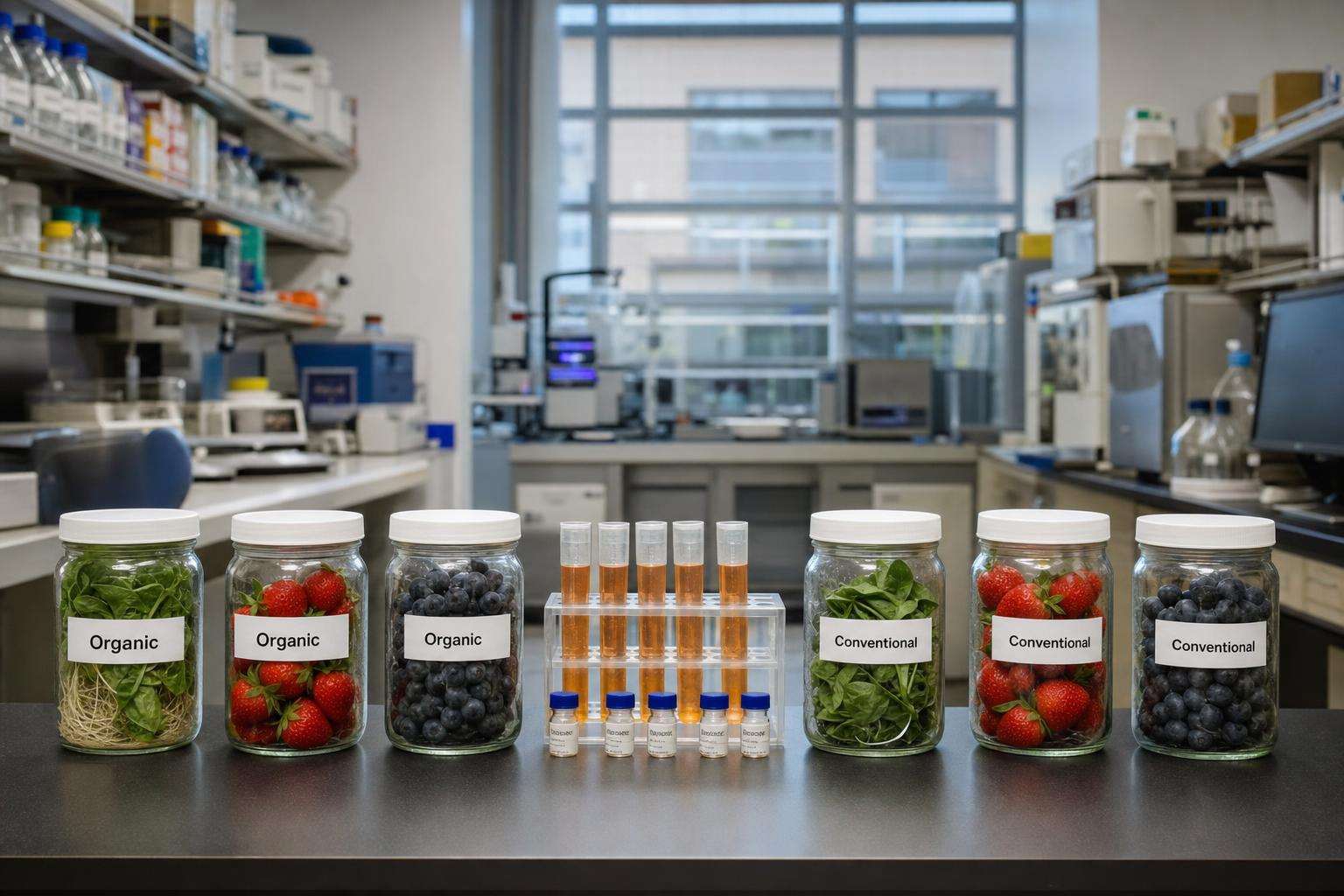
USDA PDP is market-basket residue surveillance: finds are usually below EPA tolerances. Organic shows lower synthetic detect rates (~30 pp in Smith-Spangler) but is not zero-pesticide. Detection ≠ unsafe.
Residue arguments go wrong when people treat any detect as poison or any legal sample as proof of zero chronic uncertainty. PDP helps keep the middle.
This article is informational and editorial only. It is not medical advice, diagnosis, or a treatment plan. Numbers and literature ranges cited here are not personal prescriptions. Consult a qualified clinician before changing medications, supplements, diet, prenatal vitamins, housing remediation plans, or management of a diagnosed condition. Seek urgent care for emergencies.
What is PDP designed to measure?
The USDA Pesticide Data Program samples foods people actually eat and reports residue detections relative to EPA tolerances. Annual summaries such as the 2022 PDP summary emphasize that found residues are nearly always below tolerance and overall compliance is very high.
PDP feeds risk assessment context for EPA/FDA and secondary consumer lists. It is not a cancer cohort study.
| Metric | Typical message | Source frame |
|---|---|---|
| Residues vs tolerance | Nearly always below when found | PDP annual summaries |
| Organic detect risk difference | ~−30 percentage points | Smith-Spangler 2012 |
| Compliance order of magnitude | ~99% class claims (year-dependent) | PDP/secondary summaries |
| Organic = zero pesticide? | False | NOP pathways |
What is the organic versus conventional contrast?
Smith-Spangler et al. 2012 synthesized evidence that organic produce is less likely to have detectable pesticide residues, with a risk difference around thirty percentage points, while nutrient superiority claims were weaker. Exceedances of maximum allowed limits differed little because conventional compliance is already high.
Organic’s strongest residue claim is lower synthetic detection—not toxin-free purity. Multi-residue detects on soft fruit and greens fuel cocktail debates without automatically proving over-tolerance.
How should shoppers use this without diet harm?
Eat produce first. Use organic as a budgeted upgrade on items you eat often with higher detect profiles if that matches your values. Wash produce for dirt and surface residues; washing does not erase all systemic pesticides. Do not let ranking fear shrink total fruit and vegetable intake.
For pregnancy or parental anxiety, prioritize overall diet quality, food safety for pathogens, and high-impact exposure cuts elsewhere—not perfectionism that causes produce avoidance.
What should careful readers do with this evidence?
Translate research into personal decisions carefully. Population averages, laboratory teaching values, and regulatory monitoring tables are not individualized prescriptions. Prefer primary sources—agency guidelines, peer-reviewed systematic reviews, and trial outcome papers—over social media summaries that collapse detection into danger or genotype into destiny. When a claim would change medications, pregnancy planning, major diet restriction, or expensive testing, demand an outcome study or a guideline that actually supports the action.
Keep differential diagnosis open. Fatigue, brain fog, subfertility, and nonspecific symptoms have many causes. Environmental and genetic axes can matter, but they compete with sleep, training load, iron status, thyroid disease, mood disorders, infection, and medication effects. Sequence high-yield fundamentals first, then targeted evaluation, then optional optimization.
Re-check claims when new primary documents appear. Editorial discipline means stating uncertainty out loud and grading actions by outcomes rather than by how viral a pathway diagram becomes. Reversible low-cost habits usually dominate high-cost cascades built on weak intermediate biomarkers. If a protocol cannot name its effect size, population, and failure mode, it is not ready for first-line lifestyle theater. Document what would change your mind and what finding would escalate care to a clinician or building professional.
Re-check claims when new primary documents appear. Editorial discipline means stating uncertainty out loud and grading actions by outcomes rather than by how viral a pathway diagram becomes. Reversible low-cost habits usually dominate high-cost cascades built on weak intermediate biomarkers. If a protocol cannot name its effect size, population, and failure mode, it is not ready for first-line lifestyle theater. Document what would change your mind and what finding would escalate care to a clinician or building professional.
Re-check claims when new primary documents appear. Editorial discipline means stating uncertainty out loud and grading actions by outcomes rather than by how viral a pathway diagram becomes. Reversible low-cost habits usually dominate high-cost cascades built on weak intermediate biomarkers. If a protocol cannot name its effect size, population, and failure mode, it is not ready for first-line lifestyle theater. Document what would change your mind and what finding would escalate care to a clinician or building professional.
Re-check claims when new primary documents appear. Editorial discipline means stating uncertainty out loud and grading actions by outcomes rather than by how viral a pathway diagram becomes. Reversible low-cost habits usually dominate high-cost cascades built on weak intermediate biomarkers. If a protocol cannot name its effect size, population, and failure mode, it is not ready for first-line lifestyle theater. Document what would change your mind and what finding would escalate care to a clinician or building professional.
Re-check claims when new primary documents appear. Editorial discipline means stating uncertainty out loud and grading actions by outcomes rather than by how viral a pathway diagram becomes. Reversible low-cost habits usually dominate high-cost cascades built on weak intermediate biomarkers. If a protocol cannot name its effect size, population, and failure mode, it is not ready for first-line lifestyle theater. Document what would change your mind and what finding would escalate care to a clinician or building professional.
Sources & citations
Frequently asked