Light & Recovery
Red Light Therapy: A Complete Evidence Guide to PBM
Wavelengths, biphasic dosing, hair and skin pillars, pain nulls, and why metabolic claims stay experimental.
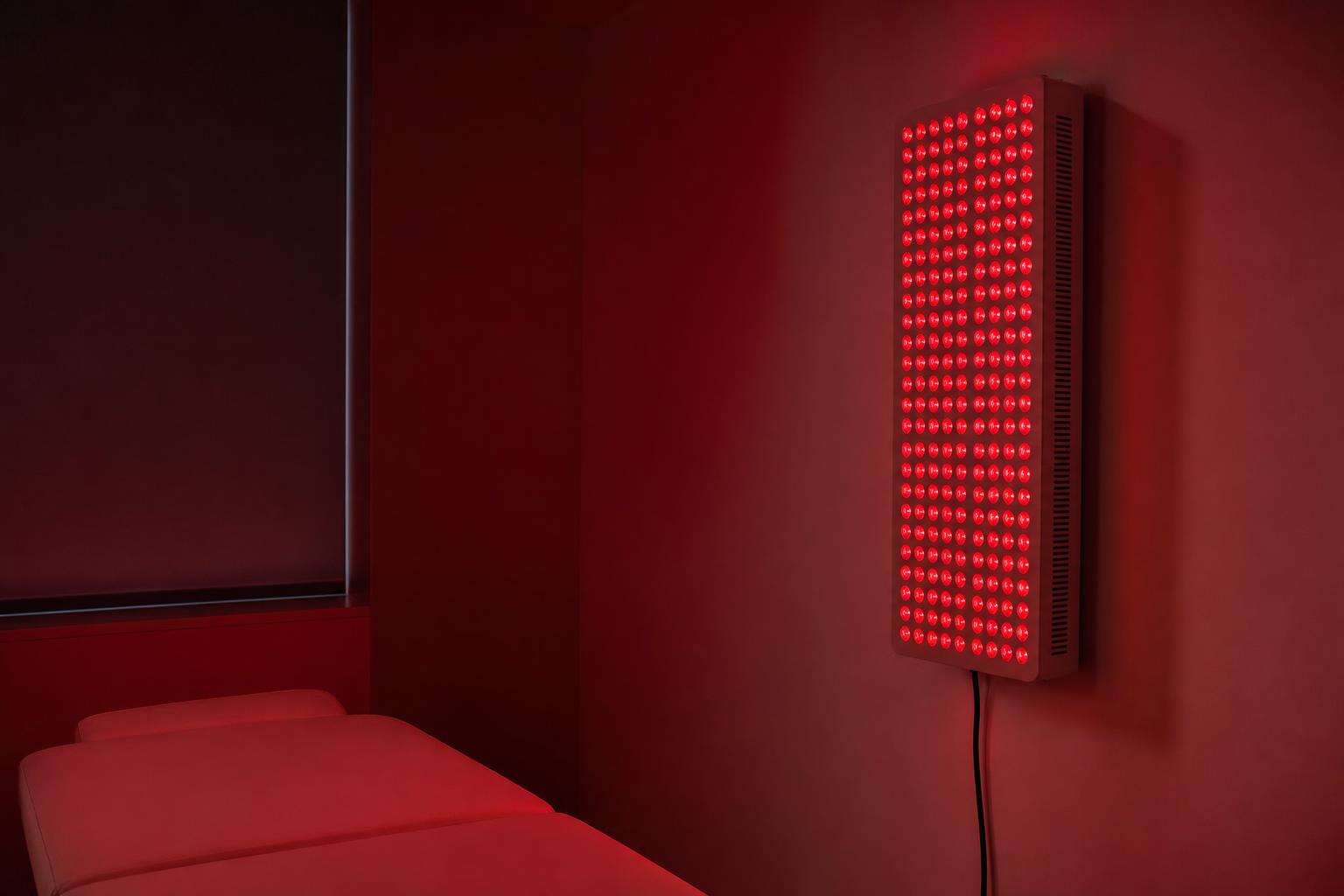
Photobiomodulation (PBM) uses non-thermal red (~600–700 nm) and near-infrared (~780–1100 nm) light on mitochondrial chromophores—chiefly cytochrome c oxidase—not heat therapy and not photodynamic therapy. The strongest human pillars are pattern hair loss and selected skin and pain uses; metabolic claims remain early pilots. Dose is biphasic: more minutes is not always better, and device wattage is not fluence.
Red light therapy is a consumer brand name for a real photobiology class with uneven evidence by indication. The editorial job is to map claims to grades, demand full dosimetry, dual-source contested benefits, and wall off hormone or diabetes cure marketing from legitimate adjunct research. This guide is a complete orientation to wavelengths, mechanisms, indication maps, devices, and safety—not a personal protocol.
This article is informational and editorial only. It is not medical advice, diagnosis, or a treatment plan. Numbers and literature ranges cited here are not personal prescriptions. Consult a qualified clinician before changing medications, supplements, diet, heat or light exposure, or management of a diagnosed condition. Seek urgent care for emergencies.
What is red light therapy—and what is it not?
PBM delivers low-level red and near-infrared photons that interact with endogenous chromophores, especially cytochrome c oxidase (CCO) in the mitochondrial electron transport chain. Secondary cascades include ATP and membrane-potential shifts, nitric oxide photodissociation hypotheses, reactive oxygen species in a context-dependent direction, calcium signaling, and transcription programs relevant to repair, analgesia, and inflammation modulation. A widely cited mechanisms review is de Freitas and Hamblin 2016.
PBM is not sauna heat, not high-intensity thermal infrared sold as deep detox, and not photodynamic therapy (which uses exogenous sensitizers to destroy tissue). Optical windows often prioritized in practice are roughly 630–670 nm and 810–850 nm class peaks; the approximately 700–780 nm region is a CCO absorption trough and a poor default. Penetration is on the order of millimeters to centimeters and depends on melanin, water content, and geometry—not brochure claims that a panel “reaches every organ.”
The biphasic (Arndt–Schulz-style) dose law is foundational: mid-range fluences may stimulate while high doses can inhibit, as formalized in Huang and colleagues 2009. Fluence and irradiance both matter. The working identity is J/cm² = mW/cm² × seconds / 1000. LED and laser sources can be comparable when spectrum, irradiance, and fluence match. Failed randomized trials should be audited for underdosing or overdosing before declaring the entire modality debunked.
Which conditions have the strongest—and weakest—human evidence?
Pattern hair loss is a relative Grade A pillar for home low-level laser and LED devices in the ~650–655 nm class used several times weekly for months. Meta-analysis by Lueangarun and colleagues 2021 reported a standardized mean difference for hair density around 1.27. Devices may hold FDA 510(k) clearances for hair growth claims; clearance is indication-locked, not a license for systemic marketing. Sex axes: androgenetic alopecia in men and female pattern hair loss in women—not a testosterone or estrogen “balance” claim.
Skin photoaging sits at Grade A–B. Controlled work such as Wunsch and Matuschka 2014 and split-face designs report improvements in collagen-related and wrinkle or roughness endpoints with multi-week red ± near-infrared courses. Literature fluences often fall in a roughly 5–50 J/cm² class for skin; Wunsch is frequently discussed near about 9 J/cm² in the red band across roughly thirty sessions. Cosmetic effect sizes and industry funding deserve transparent reading.
Selected musculoskeletal pain shows A–B signals for chronic neck pain and knee osteoarthritis when dosed carefully with point or cluster arrays. Nonspecific low-back pain has important null high-quality signals—state that explicitly and do not market PBM as a general back-pain cure. Sports recovery is mixed Grade B: Ferraresi-lineage reviews include dozens of studies; pre-exercise multi-site joules (often ~20–300 J per region class) appear beneficial in some designs, while null LED trials exist. Wounds are Grade B adjuncts for selected diabetic or venous ulcers alongside standard care—not a replacement for offloading, infection control, or vascular assessment.
Metabolic and glucose claims remain early. A 2024 healthy-volunteer OGTT pilot by Powner and Jeffery used 670 nm for fifteen minutes over a large upper-back area (~800 cm² class reporting) and found about a 27.7% reduction in the integrated two-hour post-challenge glucose elevation, with maximum spiking roughly 7.5% lower. Strengths include a standard OGTT endpoint and clear wavelength and time; limits include healthy participants, acute single-session design, modest sample size, and no chronic HbA1c or HOMA disease trial. Rodent insulin-resistance models are Grade C. Hormone optimization, primary weight-loss, and libido claims without dedicated RCTs are Grade D.
| Indication | Typical nm class | Grade | Key caveat |
|---|---|---|---|
| Pattern hair loss | ~650–655 | A | Months of adherence; adjunct to medical therapy |
| Photoaging / skin quality | 630–660 ±830 | A–B | Cosmetic effect sizes; funding bias possible |
| Neck pain / knee OA subsets | Red/NIR clusters | A–B | Highly dose-sensitive |
| Nonspecific low-back pain | Various | A null / weak | Do not market as proven |
| Sports / muscle recovery | 660/810/850 | B mixed | Heterogeneous protocols and nulls |
| Local wound healing adjunct | Red/NIR | B | Always with standard wound care |
| Glucose / IR research | ~670 pilot | B pilot / C preclin | Healthy acute OGTT ≠ T2D therapy |
How should devices, dosing, and FDA language be evaluated?
Demand a full dosimetry vector before trusting a protocol: wavelength in nanometers, irradiance in mW/cm² at the actual use distance, fluence in J/cm², total joules, exposure time, treated area, continuous versus pulsed mode, schedule, and anatomical sites. Time alone is meaningless without irradiance. Clinic contact probes delivering precise joules per point are not the same as a panel held thirty centimeters from the body. Prefer third-party spectral and irradiance measurements over brochure wattage.
FDA 510(k) clearance for a hair-growth device means a regulatory substantial-equivalence pathway for a defined indication—not that metabolic, hormonal, or systemic disease claims on a sales page are true. Consumer critical-thinking pieces, including McGill Office for Science and Society commentary on photobiomodulation hype, are useful counterweights to influencer maximalism. Industry funding should be disclosed when discussing positive cosmetic trials.
Protocol templates from trials—not personal prescriptions—include multi-week skin courses at roughly twice weekly; hair schedules of three to four sessions weekly for sixteen to twenty-six or more weeks; sports pre-conditioning with multi-site joules; and syndrome-specific musculoskeletal maps rather than one panel preset for every pain. Metabolic parameters from pilots should not be republished as patient home protocols.
What safety screens and sex-specific framing matter most?
Mild local effects dominate when devices stay non-thermal. Hard stops and cautions include unprotected eye exposure to bright sources, thermal burns from high irradiance or close contact, treating undiagnosed pigmented lesions or active cancer fields without specialist input, pregnancy (default pause on experimental whole-body fields), photosensitizing medications, and seizure history with pulsed systems. Medical retinal photobiomodulation protocols are not do-it-yourself consumer treatments. Aesthetic oncology safety reviews do not equal clearance to treat tumors with home LEDs.
Men’s strongest consumer pillar is androgenetic alopecia devices; sports recovery is secondary. Women’s pillars include female pattern hair loss and photoaging. Shared ocular and thermal safety applies to both. Claims that red light balances testosterone, replaces hormone therapy, or cures polycystic ovary syndrome are Grade D without adequate dedicated trials—mitochondrial mechanism stories do not license indication inflation.
Bottom line: treat PBM as an evidence-graded toolbox. Use hair and selected skin applications with the most mature human data; treat pain claims as dose-sensitive; keep glucose and hormone stories experimental; measure light rather than worshiping minutes; and never abandon proven medical care for a glowing panel.
Sources & citations
Frequently asked