Environmental Health
Whole-House vs Point-of-Use Water Filters: How to Choose
POE treats every tap; POU treats what you drink. Hybrid designs—sediment/carbon or softener at the main, RO at the kitchen—match real contaminant ladders.
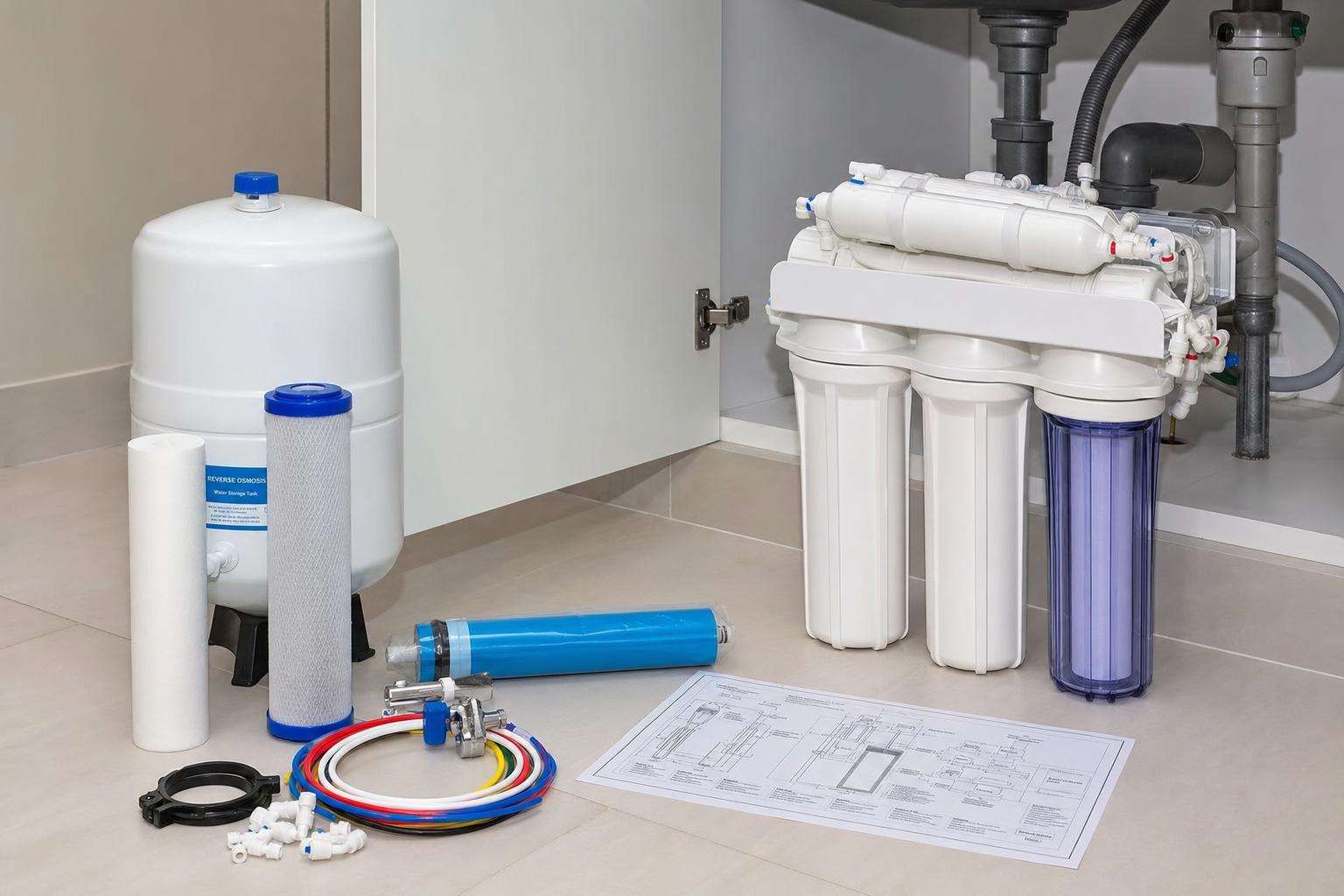
POU = drinking/cooking taps; POE = whole home. Default hybrid: POE sediment±carbon/softener + kitchen RO or certified carbon. Whole-house RO is rarely appropriate. EPA: PFAS filters ~$20–$1,000+.
Water-filter marketing collapses every contaminant into one product photo. Contaminant class, flow rate, waste brine, and which taps matter should drive the architecture instead.
This article is informational and editorial only. It is not medical advice, diagnosis, or a treatment plan. Numbers and literature ranges cited here are not personal prescriptions. Consult a qualified clinician before changing medications, supplements, diet, equipment, or management of a diagnosed condition. Seek urgent care for emergencies.
How do pitcher, under-sink, and whole-house systems differ?
Pitchers and fridge filters are low-cost POU tools strong for chlorine taste (NSF/ANSI 42) and some certified lead/VOC claims (NSF/ANSI 53) when the exact model is listed. They are weak for high nitrate, microbes, or multi-PFAS without specific claims. Under-sink multi-stage carbon raises capacity and flow for drinking water without a drain line. Under-sink RO adds a semi-permeable membrane that reduces a broad dissolved suite—including many PFAS—when certified under NSF/ANSI 58 and maintained.
Whole-house POE sediment filters protect plumbing from grit. Catalytic carbon can address chlorine/chloramine for showers. Softeners (NSF/ANSI 44 framing) manage hardness scale. UV Class A units address microbial risk on vulnerable wells. EPA’s filter fact sheet notes PFAS-capable products span roughly $20 to $1,000+ across pitcher-to-whole-home bands (EPA PDF).
| Architecture | Best for | Watch-outs |
|---|---|---|
| Pitcher / fridge | Taste chlorine; some certified metals/VOCs | Volume limits; claim-specific |
| Under-sink carbon | Lead/organics/PFAS if claimed | Cartridge schedule |
| Under-sink RO | Broad dissolved contaminants | Wastewater; remineralize taste |
| Whole-house non-RO | Sediment, chlorine, hardness, well UV | Media volume/cost for PFAS |
| Whole-house RO | Rare specialty cases | Cost, waste, corrosion risk |
When should PFAS, lead, or microbes change the design?
PFAS: point-of-use RO or GAC with explicit PFAS claims is the common household pattern; whole-home GAC is possible but media changeout is costly. EPA science notes GAC, ion exchange, and RO among treatment technologies for utilities and homes (EPA treatment overview). Lead: certified NSF 53 POU at kitchen and bathroom drinking taps plus premise-plumbing strategy. Microbes on private wells: disinfection hierarchy (UV, chlorination, or RO not as sole barrier) guided by total coliform/E. coli results.
Fluoride and nitrate often need RO or dedicated ion exchange—not basic carbon. Hardness is a softener problem, not an RO-first problem, unless TDS itself is the complaint.
What decision sequence avoids expensive mistakes?
Obtain a lab panel matched to well vs utility context. Map which taps are for ingestion. Choose POE for whole-home comfort and asset protection. Choose POU for health-driven dissolved contaminants. Budget for annual media and membrane changes—the filter you do not maintain becomes a biofilm or breakthrough device. Remineralize RO water if taste or corrosivity concerns arise for drinking lines only.
Bottom line: architecture follows contaminants. Hybrid POE + kitchen POU is the default professional pattern; whole-house RO is the exception that needs an engineer, not an impulse buy.
Across environmental-health topics, the same discipline applies: define the exposure pathway, quote primary numbers with units, separate hazard from individual risk, and choose mitigations that actually touch the dominant dose. Unregulated detox products, extreme avoidance theater, and unit-free headlines consistently underperform simple engineering and clinical basics. When agency pages update, prefer the live primary document over secondary summaries that freeze old advisories as if they were law.
If you are building a household plan, sequence matters. Confirm the hazard with appropriate testing or inspection, reduce the largest ongoing source, maintain any filter or remediation system on schedule, and use standard medical care for symptoms. That order is slower to go viral than a scare list—and far more likely to change body burden, indoor air, or water quality in the real world.
Across environmental-health topics, the same discipline applies: define the exposure pathway, quote primary numbers with units, separate hazard from individual risk, and choose mitigations that actually touch the dominant dose. Unregulated detox products, extreme avoidance theater, and unit-free headlines consistently underperform simple engineering and clinical basics. When agency pages update, prefer the live primary document over secondary summaries that freeze old advisories as if they were law.
If you are building a household plan, sequence matters. Confirm the hazard with appropriate testing or inspection, reduce the largest ongoing source, maintain any filter or remediation system on schedule, and use standard medical care for symptoms. That order is slower to go viral than a scare list—and far more likely to change body burden, indoor air, or water quality in the real world.
Across environmental-health topics, the same discipline applies: define the exposure pathway, quote primary numbers with units, separate hazard from individual risk, and choose mitigations that actually touch the dominant dose. Unregulated detox products, extreme avoidance theater, and unit-free headlines consistently underperform simple engineering and clinical basics. When agency pages update, prefer the live primary document over secondary summaries that freeze old advisories as if they were law.
If you are building a household plan, sequence matters. Confirm the hazard with appropriate testing or inspection, reduce the largest ongoing source, maintain any filter or remediation system on schedule, and use standard medical care for symptoms. That order is slower to go viral than a scare list—and far more likely to change body burden, indoor air, or water quality in the real world.
Sources & citations
Frequently asked