Environmental Health
Heating Food in Plastic: Packaging Transfer and Microplastic Risk
Food-contact plastics can shed particles and leach additives—especially with heat and fat. What EFSA, FDA, and exposure studies say about real kitchen habits.
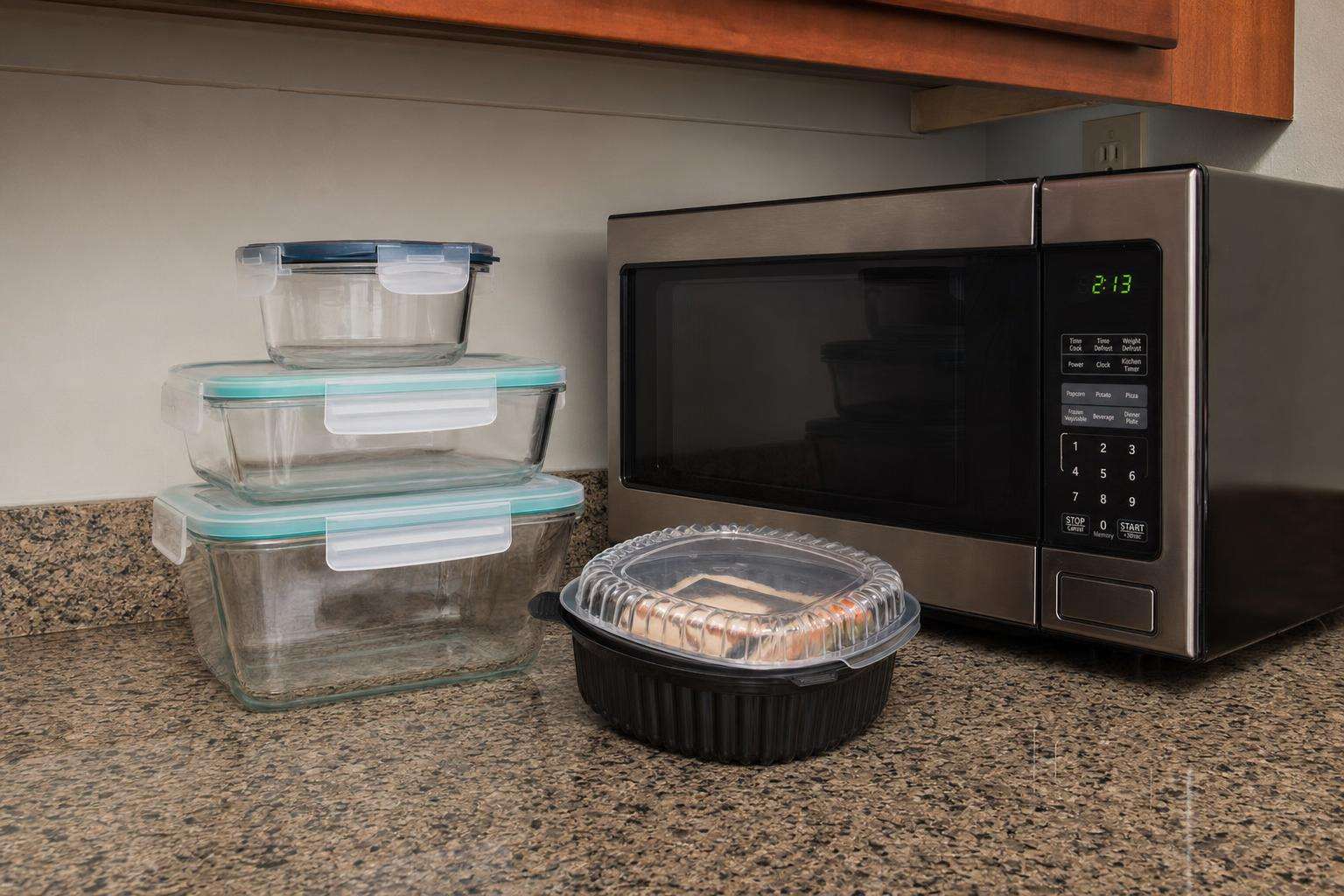
Heat × plastic × fat is the high-rate kitchen scenario for particle shedding and additive migration. Prefer glass/steel for hot foods. BPA-free ≠ microplastic-free. FDA/EFSA: detection real; ambient clinical risk still incompletely quantified.
The microwave and the takeout clamshell form a daily microplastics laboratory. Food-contact materials (FCM) can contribute both particles and leachable chemicals; heat is the multiplier most households control without waiting for global polymer redesign.
This article is informational and editorial only. It is not medical advice, diagnosis, or a treatment plan. Numbers and literature ranges cited here are not personal prescriptions. Consult a qualified clinician before changing medications, supplements, diet, equipment, or management of a diagnosed condition. Seek urgent care for emergencies.
Why does heat change plastic–food interaction?
Polymers soften and diffuse faster as temperature rises. Hot, fatty, or acidic foods increase migration of residual monomers, additives, and potentially small particles from packaging surfaces. Mechanical stress—scraping, reuse scratches, dishwasher cycles—adds surface area. That physical chemistry underpins the simple rule: do not use thin single-use plastics as cookware.
Dietary particle estimates remain method-bound. Cox et al. 2019 modeled roughly 39k–52k particles/year from a partial U.S. diet, and higher totals with inhalation (ES&T). Nanoplastic-capable methods for bottled water later reported on the order of 240,000 particles/L, mostly nano-sized, showing how analytical floors rewrite intake stories. Never convert counts to mass with meme math such as “credit cards per week,” which critical reanalyses have rejected.
| Scenario | Relative transfer concern | Swap |
|---|---|---|
| Microwave in plastic tray | High | Glass or ceramic |
| Hot soup in takeout container | High | Transfer before eating |
| Cold water in PET short-term | Lower than heat, still non-zero | Reusable bottle |
| Dry goods in plastic bag | Lower heat-driven risk | Optional glass pantry jars |
What do regulators actually claim today?
FDA’s public page on microplastics and nanoplastics in foods acknowledges detection while stating the agency has not found that measured levels demonstrate a human health risk in its current assessment (FDA). EFSA technical reporting on FCM microplastics likewise treats release as real, nano data as sparse, and some viral claims as poorly evidenced. Those calibrated statements are not permission to heat baby bottles in scratched polycarbonate; they are reminders that risk assessment lags particle detection technology.
Additives complicate the dual-hazard model. Phthalates, bisphenols, and other leachables have stronger endocrine-epidemiology tracks than particle-only endpoints in many cases. “BPA-free” can mean substitution rather than absence of concern. Particle physics and chemistry must be discussed together without collapsing them into one slogan.
How should kitchens implement a practical policy?
Write a two-line house rule: (1) hot food and drink contact glass, ceramic, or stainless; (2) plastics are for cold, short contact when needed. Keep a glass set for leftovers. Reheat takeout after transferring. Prefer untorn parchment or silicone tools designed for heat over melting disposable lids.
Layer beverage choices: habitual bottled-water reliance is a high-count pathway for many people when municipal water is safe. Layer dust and laundry fiber control for non-dietary routes. None of this requires purity absolutism; it requires rate control where temperature multiplies transfer.
Bottom line: packaging plastics are useful, but heat is the enemy of low transfer. Move the hot meal off the polymer surface, ignore BPA-free as a microplastics shield, and keep method-aware humility about annual particle counts.
Across environmental-health topics, the same discipline applies: define the exposure pathway, quote primary numbers with units, separate hazard from individual risk, and choose mitigations that actually touch the dominant dose. Unregulated detox products, extreme avoidance theater, and unit-free headlines consistently underperform simple engineering and clinical basics. When agency pages update, prefer the live primary document over secondary summaries that freeze old advisories as if they were law.
If you are building a household plan, sequence matters. Confirm the hazard with appropriate testing or inspection, reduce the largest ongoing source, maintain any filter or remediation system on schedule, and use standard medical care for symptoms. That order is slower to go viral than a scare list—and far more likely to change body burden, indoor air, or water quality in the real world.
Across environmental-health topics, the same discipline applies: define the exposure pathway, quote primary numbers with units, separate hazard from individual risk, and choose mitigations that actually touch the dominant dose. Unregulated detox products, extreme avoidance theater, and unit-free headlines consistently underperform simple engineering and clinical basics. When agency pages update, prefer the live primary document over secondary summaries that freeze old advisories as if they were law.
If you are building a household plan, sequence matters. Confirm the hazard with appropriate testing or inspection, reduce the largest ongoing source, maintain any filter or remediation system on schedule, and use standard medical care for symptoms. That order is slower to go viral than a scare list—and far more likely to change body burden, indoor air, or water quality in the real world.
Across environmental-health topics, the same discipline applies: define the exposure pathway, quote primary numbers with units, separate hazard from individual risk, and choose mitigations that actually touch the dominant dose. Unregulated detox products, extreme avoidance theater, and unit-free headlines consistently underperform simple engineering and clinical basics. When agency pages update, prefer the live primary document over secondary summaries that freeze old advisories as if they were law.
If you are building a household plan, sequence matters. Confirm the hazard with appropriate testing or inspection, reduce the largest ongoing source, maintain any filter or remediation system on schedule, and use standard medical care for symptoms. That order is slower to go viral than a scare list—and far more likely to change body burden, indoor air, or water quality in the real world.
Sources & citations
Frequently asked